
Incoming US President Donald Trump has assembled a core team that is -- not surprisingly -- overwhelmingly white and male.

'Both India and Pakistan are now, for the first time in history, very closely allied and connected with the US -- economically and politically.'

Being a pragmatist Modi is not likely to give preference to China over Japan. Both security and economic aspects are likely to shape Modi's decision in terms of engaging the two biggest economies of Asia, says Sana Hashmi.
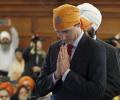
'The India-Canada relationship has suffered benign neglect. Its full potential has not yet been realised,' says Rup Narayan Das.

'A fierce crusader against communalism, George joined hands with majoritarian forces, never to revisit or re-assess his saffron association.' 'He was a Union minister in 1998-2004, a time when people like Graham Staines were lynched in Orissa.' 'On the Gujarat pogrom of 2002, George went on to kind of justify the slashing of pregnant women, by saying in the Lok Sabha that this was nothing new for India.' 'Thus, he was in sharp contrast to what he had himself stood for in the heyday of his political career in the 1970s and 1980s, says Mohammad Sajjad.

So, how does Pompeo's check list look like? In a broad sense, he is coming here 'to make sure that we have economic openness'; to ensure that 'we have to deliver'; to understand that 'we have to execute' what we promised to do; and, to 'broach some tough topics', points out Ambassador M K Bhadrakumar.

Against the backdrop of objections by some MPs, Civil Aviation Minister Ajit Singh on Tuesday strongly defended the Rs 2,058 crore (Rs 20.58 billion) Jet-Etihad deal, saying those opposing it were "long on politics and short on facts".

'India is no longer the India of the '70s and the '80s.' 'It's a large country with the fastest growing economy.' 'In working with India, you just can't go and humiliate the nation publicly.' USIBC President Mukesh Aghi tells Aziz Haniffa/Rediff.com about how he advises American companies to do business with India, what he thinks of Modi's government and the way forward for the India-US relationship.
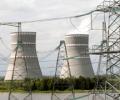
Under a 2010 nuclear liability law, nuclear equipment suppliers are liable for damages from an accident, which companies say is a sharp deviation from international norms

'If the Americans believed that India is as strong as China or Russia, would they have shown this scant respect for us,' asks Tarun Vijay, MP. 'An economically strong and militarily powerful India would never have had this experience. Not just the Americans, everyone in this world respects might. China receives respect, India gets the law book.'

'We will have to wait till the snows melt in June/July 2016 before we can get a clearer idea of whether Pakistan intends to get serious about ending support for cross-border terrorism,' says G Parthasarathy, India's former high commissioner to Pakistan.

'The Indian government has accepted and is a party to international agreements, standards and conventions on religious freedom.' 'We did not force it on them. We are not trying to impose something on them that they haven't already agreed to...' 'India has never allowed us to visit, which is very disappointing for such a wonderful country with such a rich democratic tradition. They seem to be afraid to let us in.'

'In the past the US has been reluctant to name Pakistan directly in an US-India joint statement.'

'Poverty-stricken and drought-affected families in Bundelkhand and Marathawada are selling their children for as little as a few hundred rupees.'

The Supreme Court-appointed SIT on Friday called for effective norms to curb betting in cricket and a stronger set of norms for P-Notes, while also making a case for bringing donations to educational and religious bodies under tax net.

Richard Rahul Verma, the first Indian American to serve as US Ambassador to New delhi, quips that surviving the first month in India is his first goal.

Communist China has recently developed a great expertise in 'soul reincarnation', feels Claude Arpi

'India should today tell China to provide proper facilities in Minsar for Indian yatris visiting Mt Kailash,' says Claude Arpi.
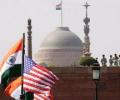
The American influential IT and telecom industry sought intervention of the Obama Administration against what they alleged are "discriminatory" Indian policies, which they claimed has resulted in several hundred millions of dollars of losses in the last quarter.

'Just how strong were the ties between the world's largest and oldest democracies that an incident involving a diplomat and a maid led to anger threatening the relationship itself? Or had the relationship been weakening in the past few years, masked by the empty symbolism of State dinners, asks Devesh Kapur.

This is the joint statement issued by the ministry of external affairs on the visit of US President Barack Obama to India.

Even as the United States snuggles closer to India with the thinly veiled objective of containing China, the Indian strategy is to avoid alienating either nation.

'The previous (Congress) government at least did not veto provisions of the cattle laws.' 'The BJP is actively weakening the provisions.' 'The BJP government tried to export goats from Nagpur for slaughter to the Middle East.' 'The whole country was aghast and offended. We are a country of Ahimsa.' 'The BJP has incentivised the butcher industry so meat export has gone up, live animal export has gone up, leather export is on the rise, smuggling has gone up.'

Why is Xi Jinping visiting Saudi Arabia, Egypt and China this week? Former RA&W officer Jayadeva Ranade explains the significance of China's outreach to the Middle East.
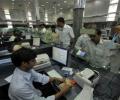
For the first time in our economic history a government has thought about more than 50 per cent of our economic activity instead of the five per cent represented by the Sensex companies, observes IIM-B professor R Vaidyanathan.

The government must justify why we need to buy foreign reactors when we have developed up to 700 MWe unit-size pressurised heavy water reactors, a design which can be easily extended to 900 to 1000 MWe unit size. Why can't the 'Make in India' philosophy apply to indigenous nuclear reactors, more than 18 of which have been designed, built, and being operated by Indian engineers, asks Dr A Gopalakrishnan.

The prejudices the Chinese carry with them mean they are not natural global managers.
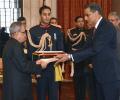
'India is part of our strategic and economic future,' says Richard Rahul Verma, the first Indian American to be appointed US Ambassador to India.

Five longtime Republicans -- K V Kumar, Puneet Ahluwalia, Suhail Khan, Ajay Kuntamukkala and Harry Walia -- have been named to the GOP's Asian Pacific American Advisory Council.
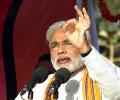
The kind of people Narendra Modi has chosen, the decisions he has taken and the rail and central budgets suggests that he is treading carefully in New Delhi. There is less of innovation and more of continuity, so far. He is not ready to rock the boat and start from scratch, says Sheela Bhatt.
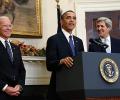
'The threat that India faces and the threat the United States faces is not just to the homeland, but to our people and to our institutions wherever they may be.' In an exclusive conversation with Aziz Haniffa/Rediff.com, US Assistant Secretary of State Nisha Desai Biswal outlines the importance of Prime Minister Modi's visit for America.

Moving ahead with their new mantra -- Chalein Saath Saath: Forward Together We Go -- Prime Minister Narendra Modi and United States President Barack Obama on Tuesday vowed to deepen cooperation in every sector for the benefit of global stability and people's livelihoods over the next ten years.

'The Modi-Xi and Modi-Obama meetings, with an interval of just 12 days, are juxtaposed superbly at a crucial point in the prime minister's life. Can Modi carve out a win-win situation with the superpower and the emerging superpower at the same time?'

'Our approach to India is no different from the approach that we have made in India over the years, recognising its non-aligned status. That's their decision; we're not trying to change that. We have common interests, and we have actually built on those common interests... We think there's more potential to build on those common interests.' 'Security, stability, freedom of sea lanes, economic development, energy, all those are certainly in the interest of India and the region, as they are to the United States.' The transcript of US Secretary of Defence Chuck Hagel's interaction with reporters travelling with him hours before he landed in New Delhi on Friday on a three-day visit to India.

'We are encouraged by what the prime minister said recently on these issues... We will keep a close eye on these issues. They are very important and as are other elements of our human rights and religious freedom.' 'So, absolutely, we'll keep a focus on them.'

Let Bihar be damned under its contradictions of having gone 'dry' and then having been submerged under flood, which is a recurrent phenomena? After all it is a godforsaken land, having lost its promises of overcoming its problems, says Mohammad Sajjad.
 © 2026 Rediff.com - Advertise with us - Disclaimer - Privacy Policy - Sitemap - Feedback - About us - Terms of use - Grievances